
Blog · 13 October 2026
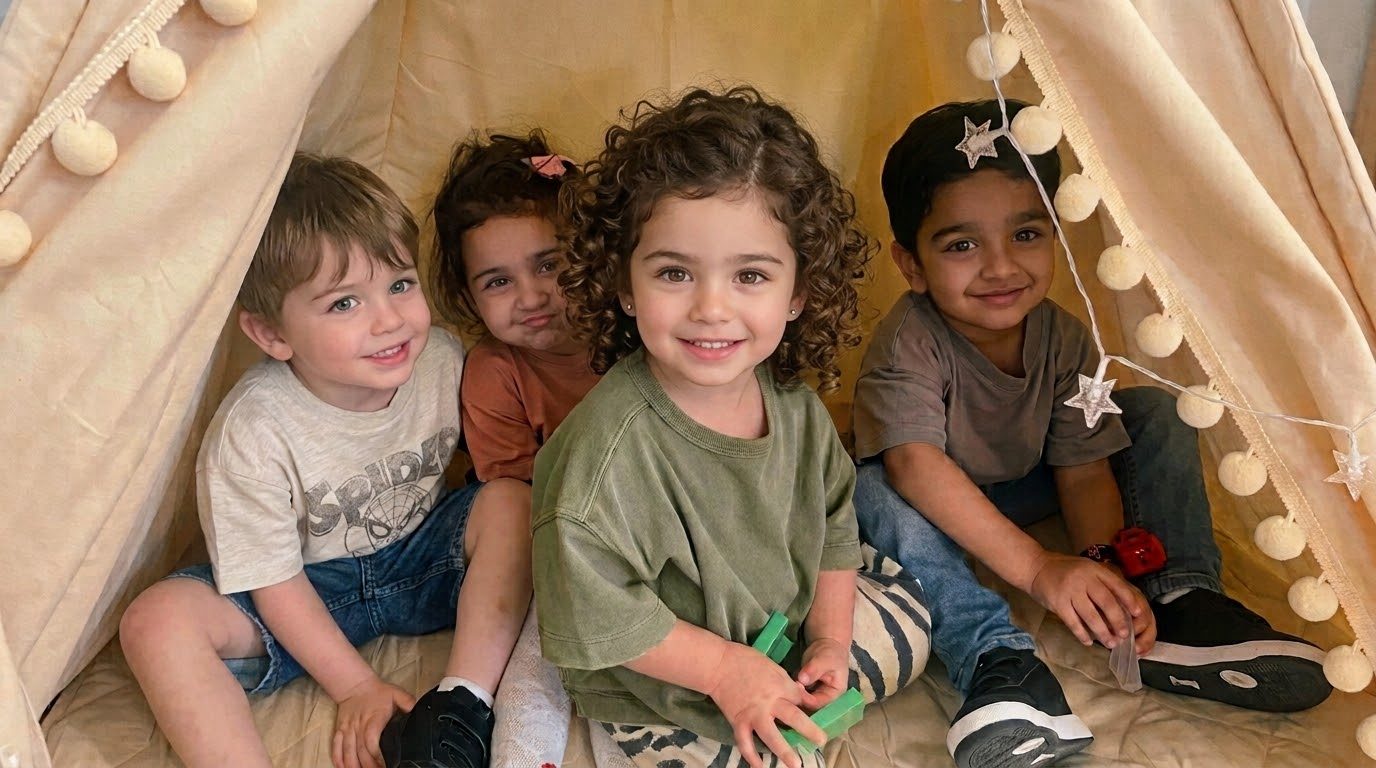
Why young children learn more together: what the research says about early learning centres

Many families in Dubai weigh up the same choice: keep a young child at home with one trusted carer, or start them at a nursery. Both come from love. Care at home can be warm, safe and familiar, and a good carer gives a child a great deal. What a quality early learning centre adds is different: other children, trained early years teachers and a place designed for learning. Here is what the research says.
Friends are part of the curriculum
Sharing, taking turns, joining a game, sorting out a disagreement: young children learn these with other children, not from adults alone. The largest UK study of early education, the EPPE project, found that time in pre-school, compared with none, improved all-round development. Children who started between two and three were more sociable with other children when they reached school (Sylva and colleagues, 2004).
More words, more conversation
Language grows through back-and-forth talk. In a nursery, a child hears and uses words with teachers and with a whole group of friends, through stories, songs, questions and play. When Norway expanded nursery places for children from age one, a study of more than 63,000 children found better early language skills (Dearing and colleagues, 2018). The US NICHD study found that children in higher-quality care had somewhat better language and early learning up to age four and a half (NICHD, 2006).
Ready for school, and beyond
The benefits can last. The same UK children were followed to age 16. Those who had attended pre-school did better in their GCSEs, and the gain was larger for children who started before three or went to a high-quality setting (Department for Education, 2015). UNICEF reports that, across the countries it has data for, children who attended early education were more than twice as likely to be on track in early literacy and numeracy (UNICEF, 2019).
Independence and self-control
Waiting for a turn, remembering a plan, switching from play to tidy-up time: these are executive function skills. Harvard’s Center on the Developing Child explains that children are born with the potential for these skills, not the skills themselves, and that they are built through relationships with caregivers, teachers and peers, and through the places children learn and play (Harvard Center on the Developing Child). EPPE also found more independence and concentration in children from high-quality centres.
Room to move
Many Dubai families live in apartments, and young children need space to run, climb and dig. A review of 23 studies found that outdoor spaces with varied play options and natural features increase physical activity and cooperative play (Taylor and colleagues, 2024). A study of 1,335 child care centres linked better space and time for active play with better self-control and behaviour (Tandon and colleagues, 2020).
Quality is what makes the difference
The research is honest about one thing: not every nursery helps. The benefits depend on trained staff, warm and responsive teaching and a planned curriculum. A rapid, low-quality expansion of child care in Quebec did not bring these gains (Baker, Gruber and Milligan, 2015). Very long days from infancy can be hard on some children, and EPPE found full-time attendance gave no more benefit than part-time. And home still matters most: reading, talking and playing together as a family shape children more than any setting.
So the question is not only nursery or home, but which nursery, for how many hours, and alongside what at home.
What to look for
On a visit, look for teachers on the floor talking with children, small groups, a calm room, real materials and daily time outdoors. Ask how teachers plan for each child and how they share progress with you. Our 10 questions to ask on a tour will help.
Learning together at evergreen
evergreen is a brand-new, Reggio-inspired EYFS nursery in Umm Al Sheif, near Umm Suqeim 3. We keep small classes, calm rooms with real materials, and 10,000 sq ft of outdoor space with a real garden. Admissions are open, with flexible start dates and timings. Book a tour and see children learning together.
Read next
- How to choose a nursery in Dubai: 10 questions to ask on a tour
- Clean air for small lungs: why we filter the air in Dubai
- Learning through all the senses: why touch, smell and sound matter before age five
- Rest is part of learning: why we built a dedicated sleep area
- Why greenery matters for young children in a city like Dubai
- Why small class sizes matter in the early years
- Settling in: helping your child through the first weeks
- Arabic at nursery: why early exposure to a second language matters
- Starting nursery mid-year: why September is not the only time
- How to choose a nursery in Umm Suqeim
- Reggio vs Montessori vs EYFS: which suits your child?